Dr. Paul
Maigret and the Dead GirlDr. Paul is the medical examiner whose findings turn the unidentified woman’s body into a set of investigative clues without pretending those clues tell the whole story. His postmortem work gives Maigret a clinical account of her condition and death, while its limits leave the circumstances to be pieced together from other evidence.
Identity and Forensic Role
Dr. Paul arrives at the Medico-Legal Institute at half past four, preparing to begin a postmortem. His white gown and cigarette are familiar features of his working routine. When Maigret asks about the woman, Dr. Paul estimates that she was between nineteen and twenty-two, in generally good health but probably undernourished. These findings distinguish her physical condition from the outward impression created by her worn clothing, without identifying her or explaining how she came to be in Paris.
His initial examination identifies a skull fracture as the cause of death. He reports that she had received several blows to the face before the fatal head injury, but cannot determine the exact weapon: a heavy tool or another hard object could have caused it. Later, after the full examination, he adds that she was struck at least three times. His account is precise about the repeated violence, but cautious about the object used, preserving a distinction between the medical conclusion and speculation about the instrument.
Dr. Paul also reports signs of a struggle. The woman had fallen to her knees and tried to cling to someone; dark wool fibers beneath her fingernails suggest that she grasped a person wearing wool clothing. He says this points toward a man’s clothes, but the fibers alone do not establish the person’s identity. He sends the material to the laboratory, making the trace evidence a testable lead rather than a finished answer.
His estimates of intoxication and timing further narrow the inquiry. Dr. Paul judges that the woman was at least three-quarters drunk and promises a laboratory measurement of the alcohol in her blood, along with an analysis of her stomach contents. He estimates that she ate six to eight hours before her death and places the death at about two in the morning, probably earlier rather than later. These are working medical conclusions, not a reconstruction of where she drank or what happened in her final hours.
The Report as an Investigative Clue
Dr. Paul’s postmortem findings also help Maigret test accounts of the woman’s final evening. The report records an appreciable quantity of alcohol in her stomach, while the head waiter says she had little opportunity to drink during her short stay at the Roméo. Maigret therefore considers whether she drank before the reception, perhaps to give herself courage, or afterward, before her body was found on Place Vintimille. The medical evidence narrows the possible sequence without settling where she drank.
The distinction between a general finding and a specific result becomes decisive when Maigret confronts Albert Falconi. The newspapers had reported alcohol in the woman’s stomach but not the full postmortem result: it was rum, not the gin-and-vermouth mixture in a martini. Maigret uses that discrepancy, alongside his reconstruction of how she behaved at the bar, to expose the weakness of Albert’s account. Dr. Paul does not identify the killer; his careful examination supplies a fact that lets Maigret distinguish a plausible-sounding story from the evidence.
Manner and Presentation of Findings
Dr. Paul’s manner gives his medical reports a measured but personal rhythm. Before disclosing the degree of the woman’s intoxication, he pauses as he does when telling one of his anecdotes and smiles slightly, anticipating that the information will surprise Maigret. The moment does not replace the evidence with performance: it shows how Dr. Paul introduces a consequential finding, then anchors it in the report and further analysis still to come.
Medical Findings in the Larger Reconstruction
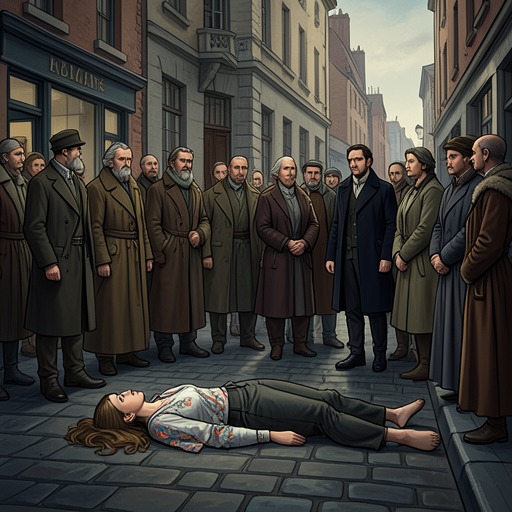
At the scene, Maigret initially considers whether a woman from the nightclubs had been attacked on her way home and robbed, but the missing shoe and removed coat make that explanation less convincing; he concludes that she must have been killed elsewhere. Dr. Paul’s examination strengthens the distinction between where the body was found and where the fatal events occurred, while leaving the location itself unresolved. The contrast shows the limits and value of his role: medical findings can establish what happened to the woman’s body and add testable clues, but they do not by themselves reconstruct the crime scene or identify the killer.